
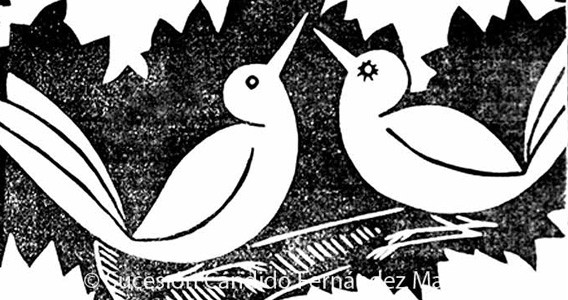
It informs the Treasury ... From Covarubias from the seventeenth century debuxar is "delineating a figure without giving color or shadows, but only take profiles", it is clear that the definition should be the exact complexly form not only of the work of Cándido Fernández Mazas, but in his statements about whatever this task, your ideas come to ascetics reduction criteria proposed by this dictionary. Reduce as a method of finding profiles. This same text would be a drawing, follow these indications as a portrait, either of an author, a theme or a perspective on both, must necessarily operate on this criterion.
It must break the multiplicity in which a life is resolved to find and define profiles, which can now be synonymous with perimeters, contours, areas, surroundings, circuits, silhouettes, sides, edges, limits, fences, journeys, places, proximities, tracks, borders, places, margins, demarcations, positions, itineraries, zones, environs, traces, placements, edges, areas, lines… scratches. As such, every text contains a portrait, an ascetic selection of information that aims to allude, evoke or circumscribe information that is impossible to be contained in or by signs. According to the summary that Santiago Arbós proposes to us from a conversation with the author, drawing for Fernández Mazas must possess that quality of relationship with the laws of austerity: "An autonomous drawing cannot pretend to capture either color or volume. The first belongs to the field of painting; the second to that of sculpture." Delimitation of spatial and conceptual time, development proposal and proposition of each starting point, in its radical tranquility of results, of a series of problems that, as proposals thrown in front of whoever designs them, opens up in a plethora of senses. If the work is one of reduction, of finding/searching for the drawing's own territory - this is how meaning effects the contrast with two other genres, painting and sculpture - how is the reference, the story, produced, that is, making the material reintegrate into that totality uncontainable by signs, from which it ultimately comes? If we continue with Arbós' story, the solution is clear, as it is also clear that a series of problems are reopened from it: "For drawing, it does not matter whether a woman is blonde or brunette. Volume can only be alluded to." In Cándido's graphic work, the search is for essential, naked or “pure” forms, in which an allusive mark remains towards the experience not directly contained in it. They are emptied, then, images in transit. The problem that the term allusion opens now arises when it turns in on itself. The allusion alludes. With a certain speed to illusion, avoidance and play, through its common Latin root ludus, game. To allude is etymologically “to joke or play with someone”, and in these graphics the verb makes sense, since any of Cándido's figures is a survey along the lines in which the liveliness of the stroke can initiate the paper as an illusionist board. We had already indicated the first of the terms connected to that: autonomy - the way in which a genre gives itself its own law independently of others - is the austere search for the profile (let us also note this term), avoiding - taking out of play everything that would turn the illusion into a blurred form -, with too many meanings, with too many intentions, with too many consequences. Impoverishment of the line, as an authentic transformation of it into a line of flight or perspective of meaning. And, now, the norm of the configuration of meaning: feeling the vitality inherent to what we refer to. The figures appear. The second of the terms in connection is that of illusion, as a prelude to participation in the lines that have now been transformed into signs for us. Taking the most pragmatic or Piertian definition of the word sign, we could define it as something that has been arranged in the place of something, in some of its respects. Let us also remember that respect means – according to its Indo-European radical – speck lat. rispectare–, place from which one looks back. Illusion is the way to participate in that hidden meaning that the author's experience has wanted to extract from the figure and present it to us allusively so that it can be completed again. We are not interested in a sgraffito dove but rather in autonomous drawing. “A real apple is never a painted apple,” the author informs us, as an architectural intention to clarify the space in which creation occurs, against which art works and that art supports. We are interested in the sign in your suggestion. Sign, in general, is also defined by any sensitive entity that allows recognition of a fact that is not perceived. The "it doesn't matter..." in the previous quote by Santiago Arbós coincides splendidly with the Picasso saying "if it is Saint Antón with a beard, if not the Immaculate Conception", which summarizes the autonomous importance of the sign compared to what it supposedly comes from as its origin, compared to the model. We are interested in the way the vitality of that reference is extracted, or how it is involved in the work and can be deployed from it.
Again Arbós' reference: "Don't waste time doing what everyone else does. Buy a fountain pen and draw firsthand, freehand, trying not to make dead lines." What will that death be for the line then? Literally its loss of function. Death explained as the capacity to evoke, to excite, to bring something more than the present, the apparent. A dead line, like the dead metaphor that Ricoeur alludes to, will be one that does not refer to any space other than the present, that does not allow one to cross its perspective (look through) and live in the least reduced and summarized in it.
There is nothing easier than rambling. Nor is there anything easier than remembering, not of what is alive but of what is painted, cartographies of bygone times, fashion prints, vignettes, etc., etc. 1
Does vivifying lines have to be something that literature also shares as a medium? Or perhaps not all the reflection, up to this moment, has been focused on an intermediate ground of indiscernibility between graphic or written sign? The role that the line must have now is to remember what is alive, to engram in it, in a percussive and effective way, the value, the perspective, the transparency of its mystery to be unraveled. It is a curious fact, after the search for specificity of the drawing, that it appears increasingly closer to the word. It is not surprising that one of the most important developments of this century is this, that of the graphic encounter between the simultaneity of the graphic and the supposed linearity of written discourse. Gonzalo Torrente Ballester, who met Fernández Mazas in 1930, proposes a double opinion on this particular point: “He had the double gift of words and of the hand, and he spoke of his literature as of his painting: as a bunch of problems, rather than solutions”: The first part of the statement is, to say the least, confusing. There is no double gift, unless we understand that what is folded carries within itself a complex relationship to the point of paradoxical terms: at one time it is half and at the other it multiplies by two, on the one hand it is the folding that reduces the material and on the other the unfolding that turns it into its double. Torrente Ballester does not refer to this idea, in any case, but to the more common, although inappropriate, idea of being between two camps. This is not the case, but the space that is delimited is that of duplicity, that is, the falsehood of someone who does two things at the same time, calculating the place of each of them and multiplying in an illusionistic – sleight-of-hand – way their possibilities in a paradoxical mixture. Writing or painting: it is the same in its differences. The same as it is a living, vivid line. Different in that the distance of the signs is proposed as such. Now logic becomes something a little more blurred, an option that often appears when dealing with art. What should dissolve or solve distances becomes a problem. Well, at the same time that it shows us a direction, it shows itself, as a traffic light, as the bearer of the sign or the nod towards another part. Because every artifact, therefore every drawing, shows the unbridgeable distance between what appears, what it represents in the distance and the way in which access and communication between the two could occur, playing in it, in the clarification and determination of all the exchanges and implications of the game, the life and death of the process, its meaning or its non-sensus, its gratuitousness.
It is nothing more than illusion, the way of jumping over an insurmountable distance, participating in a game with the twilight awareness that there is some truth in it. Thus, whoever does not participate in a game is a spoilsport, whoever says, for example, what we all fear in front of a drawing. By truism: it is not a dove, it is just a drawing. Magic or sleight of hand is this: showing what is dead, done with violence, as alive and full of interest. If we return to Covarrubias, we find this same criterion of illusion, but within the word allusion, with which we began to see the intentions of Cándido Fernández Mazas.
ALUDIR: We say one thing, and underneath its words we give intention of another.
It is about altering, after all, through an activity, the space in which it is presented. As in sleight of hand, it requires participation, since it is always a deception: but perhaps as Picasso says, a necessary lie, since it teaches us to tell the truth, Show clear truths with an obscure reason. And truth is not a result but a perpetual displacement of meaning. The process of its entrainment and deployment. The illusion is a mockery, the mockery of the limits that a space imposes on each object. Illusion is an evocation, a call to what is not contained in an operation as simple as delimiting a series of directions by placing them on paper, with a certain contrast, waiting for it to be discovered by a reader or clairvoyant.
Well, discovery before the vision, by the vision: countervision then. Measurement and rhythm of the world through lines that are above all conceptual positions. Fernández Mazas's expression is not ahead of its time – I would like to emphasize this point consecutively – but rather it is epoch-making. It does not depend on the advances of his time, his contemporaneity, or whether his discoveries were prior, parallel or later than those of Picasso and Matisse. He participates intensely in them, through a reading of the globality of the signs that they share and that, in an erudite manner, he details in his writings. Cándido also reminds us, in Ortega's mouth, how inventing is nothing more than a means of finding things. The value of his work is autonomous, as he claims for his graphics.
Ultimately, an artist is an inventor of a medium. Therefore, in art, there are only two phenomena. When the artist is a product of the medium – temporal medium; when the medium is a product of the artist – universal medium.
His position regarding creation is conceptual, but he does not testicularly claim data or theory; he exercises, through a tortuous plastic reflection, the uncomfortable task of someone who has a huge bag of problems to propose. The second part of Torrente Ballester's sentence that we proposed as an example is important in its accurate lapidary aspect: "and he spoke of his literature as of his painting: as a bunch of problems, rather than solutions." All of his drawings propose this tessitura, rather than a thesis. Each form arises from a provoked mental action, from an exercise that makes the hand think and the body speak, and the eye write. All his drawings are made on the body. Understand this phrase in its fold. The proposal is a coordination between that vitality that he so eagerly seeks in his writings: the everything poured into each concept space of creation. Sincerity of error maintained. As Cándido writes about Manolo Méndez:
In this constant towards the truth, knowing that we will never reach it, develops […] almost everything that art has as a game.
Game techniques would be the ones that define the closeness between painting and writing graphics. Tension of the desired, of the sought, the role that the critics of other artists prepare in their reflections. The pictures of others are a reflection of the vital tensions of the handwriting of the person who speaks. Speaking of a contemporary painter, Santos Balmori, he tells us what he is missing, to illustrate with an example: “to find a vital balance, a certain reference, to those lines and to those colors, to put an order […] to that painting”.
The elements of this literary portrait of Cándido Fernández Mazas are organized. On the one hand, the obsession focused on drawing, which essentially extends to his oil work, which is structurally focused on the support value that lines offer on graphic reflection – as in the case of Picasso and Matisse and, saving the distances and the necessary contrast, Giacometti. The constant approach to graphics is carried out through an essential search for the specialties of the medium, its schematic reduction of a multiplicity of phenomenal presences to a line in which a profile must be summarized that dialogues with what is excluded from it, which at this moment emerges as a fundamental reference. And this is what Cándido Fernández Mazas states, in a comment on Goya's pictorial romanticism:
[…] It is not in his humor where his origins are found, but in his usual desires, in his most romantic desires, those impossible to bring the totality of life to the table. (As if it, life, could be determined in totality, being impossible, since it is determined in units.)
What is excluded by the profile will be life or the vital impulse, a great theme for these drawings, the grail of his search and also the driver of his reflections on other works. In the quote to Santos Balmori proposed above, the requirement is that of a vital balance, and this clue in the method, by dint of its recurrence, leads us to connect his approach to creation, through a conceptual system, to the vitalisms and ratiovitalisms of the beginning of the century, which go from the death of Nietzsche to the revaluation of aesthetics as knowledge of that life that can only have aesthetic justification, with its lightened version Orteguiana and its Bergson-Machadian courses. Life is sought through a reflection on the impoverishment caused by any means of capture. The profiles according to which it could be circumscribed in the work, through which it could be portrayed, are investigated.
[…] the worst thing is that the paintings must be in vitality and in paint: life imprisoned in an order. Because the other thing is to skip life to the bullfight to kneel before the emptiness of shapes and colors.
The themes of his graphic reflection appear according to this motivation. Fundamentally figures, and like figures, portraits, even in the case of a still life. French musicology, especially Boucorechliev, has used the term “rostrification” to talk about the recognition that occurs upon the arrangement of any material. In a face, as anyone who has tried to play with the mathematics of resemblance cruelly knows, microdistances cause the recognition of the distance between elements. Modifying the space between the eyes, between the mouth and the nose, produces a deformation of the referentiality, a strangeness about the possibilities of referentiality on the model. If in Cándido's work the central material is portraits, and we have argued that the autonomy of drawing is one of his concerns, his elaboration of portraits necessarily involves an assessment of the rules, measurements and mathematical norms of recognition, before the fabrication of caricatures. The exact difference between caricature and portrait is this, on the other hand. A caricature loses meaning if we do not have the model in our memory. In a portrait, it is the distances and autonomy of the work that are of interest. A portrait, an autonomous, silent and statuary entity, is also different from a vignette, a term that in his writings has a pejorative tone, in that the vignette is part of a sequence that is somewhat expected, predictable, and which in turn comes from an established story. Everything is a portrait in some way, in its graphic creation. As we have been saying, search for the profiles that define, painful and calculated selection, gymnastic of how an autonomous recognition can be produced in the works, of the works. Let's recover Covarrubias' exact definition: "delineate a figure without giving it color or shadows, but only taking its outlines." This text, in its graphic attitude of recognition of a reference, is a portrait of the graphic work of Cándido Fernández Mazas. From this tautology we extract that the work of the (d)writer will be the violent task of selecting the relevant data so that autonomy and reference of the text coexist. Select as a way of reading, of choosing the appropriate profile, not deformed or amorphous, but in accordance (subject to and of) order, rhythm, measure. Covarrubias also provides us with a subtle definition of profile, which helps this sense: “The last part of the figure that is understood with an imaginary thread, within which everything else is contained and thus it was said PER et FILO.” Circular game of definitions, Fernández Mazas illustrates this way of acting. Not only in the form of formal weaving, of spinning with a feather or a measured and exact profile, but also in terms of the ultimate aspect of the figure is represented in his work by the expiration of the contents that could distract from this essential game. Pure contrast, black and white, slight color variations, in some cases with connotations of distant, metaphysical painting. Search for the emptied white and the reverse construction of the drawing: monumentality achieved through the slight sketch, the scratch on the page. Never through crowding, disorganization or disorder. Search for clarity, precision and conciseness. Antinihilism, of course if we bring Giacometti back to presence as a place of a project method established on doubt and another that claims mathematical knowledge. The mathesis of the portrait, of the radical importance of microdistances in the portrait, of the conceptual, rhythmic, melodic and harmonious capture of life.
I call value any mental consequence of a measurement, that is, a consequence of physics-mathematics. Algebraic or reduction values, that is, universal, synthetic, and arrimetic or progression values, that is, analytical. (Ars Moriendi)
Ordering as mathesis is the norm that appears as an exact method, confronting the vagueness that the Impressionists represented, for example, and that Matisse annihilated. Mathematics is a method of diction, the search, in a Cartesian way, for an intuitive, rigorous and clear rule:
[…] it is always sensitivity that loses us, that makes us wrong. There is a big problem to solve. The one that was said about the two dimensions within a clear, rigorous, precise diction.
Reality can be said through a rule of composition of intuitive distances, those that arise from the reducing and expanded observation of the rostrification of the world, from the portrait of all its elements in an allusiveness that appears as a horizon behind which we can peek, behind a void that is filled with foresight. Perhaps measurement is the formula most used in his writings, the search for an order, or the secret order in which the figures begin to live. Whoever loves life counts it, tastes it, measures it. The annihilation in vagueness is not only that which comes from impressionism, against which he reacts, but that which will decay in the post-war period that he no longer witnesses, with the fall of the Enlightenment ideals that in some way lay in his graphic and reasoning pretension in another new and literal annihilation of meaning, nihilism. Again, Picasso and Matisse, in their neoclassical periods, are a close reference in their post-Cubist or post-Cezanaan intention to interpret the exact situation, through the introduction of time, of the objects. But the Giacomettian fall, the one that crosses surrealism and falls into existentialism, powerfully illustrates Candide's intention. Uniting inert object and flowing life through graphic sleight of hand as a way of investigating the problems of human knowledge, but starting from life, would be the position of Fernández Mazas. It is known for a repeated anecdote that made Giacometti spend much of his life sleeping with the light on: the vision of a fly that entered the mouth of a dead friend made him see, as in a negative satori, the indifference of death and life. Its inert objects are lacerably mortal. Its intention is to introduce the void of nothingness into matter; that of Candide, to revive the vitality of the inert with the fertile contact of the void.
Then color does not remain as its own essential reality, as an influence of life, but as a measure of it.
Measurement is always a comparison that brings into presence the two extremes, the present and the absent as absent. It formulates a pattern that allows relationally to suggest presences, contacts, connections. In short, it involves a calculated presence with a planned absence. The measure extracts from reason a comp-parare, a common disposition, a distance bridged by being stated as a possibility. If we are only given parts, and not the entire world, choosing the measure and seeing the rhythm inherent in the choice will be a way of transforming the part into a participant in a game of illusions. The object lives, “boils and delivers relationship,” in the words of Lezama Lima.
Approach. You always see what you instinctively possess at the moment you open your eyes.
The effort of data extraction, the anguish that authorship entails is another of the defining factors of these drawings. We have talked about sketches or scratches, traditional definitions applied to minimal drawings, as a means of highlighting their preparatory nature, which points towards something, be it another work or another result. The convenience in this case is obvious. The lines are exploratory forms that investigate the mathesis of recognition, therefore of knowledge through forms. The self-exploratory nature of art appears clearly here. It is always necessary to quote Rembrandt again, who affirms that all his works are self-portraits, to add the Greek root autotos, to this self that seeks a dialogue with the vital. The profiles, in a Borgesian way, of the portraits of others coincide with the slow tracing of the process of self-exploration and recognition of that “for itself”, in which the autonomy of the drawing is projected to the intended autonomy of the self staged in its profiles. The tattoo is, again for the author, the mark of this autonomization of meaning, from the body and in the body. Its greatest example, in front of the cave, where a projection of meaning occurs on the object, on the surroundings. In Mazas's subject matter, this duality exists: on the one hand, portraits in which the work of inquiry and self-inquiry are the premises. In another, his social work, focused on a project elaboration of his critical sense of his time. The self is nothing more, then, than the synthesis of its multiple profiles. Or the selection of these ready to be developed. The self is nothing more than an artistic projection. Again in collusion with Nitzschean aesthetic vitalism.
Once the noumenon is found, the artist departs towards the synthesis. From the complexity of his “not-I”, he removes, as an amorphous element, everything that is anecdotal about things. Select, then, the synthetic painter, towards the universal.
From the mathesis that seeks a law, we can move on to the application of that law in different fields. Polymathy, specialization in a multiplicity of knowledge, is a very common figure in the history of human thought, in contrast to the alleged specialization of those who choose only one of their traits to present themselves. Polymathy – from mathema, wisdom – supposes the strength of recognizing oneself beneath the metastatic multitude of a series of knowledge normally weighed down by an excess of specialization of those who choose just one of its specific features of the diverse relationship between knowledge and life. A trait of strength, as well as a painful rank to accept in a society where the personal development required involves specialization that produces a quick and reassuring recognition of the position that each one occupies, not only writer or painter, but playwright or poet or novelist, or draftsman or illustrator or dilettante. Not having a sclerotized feature does not mean that it does not exist, but rather that it is found to a different extent. Through scratching we can easily understand the relationship between profile – selection of that imaginary thread – and feature, stroke, according to María Moliner. "line drawn when writing, particularly when it is ornamental or when drawing. Sketch" In the ornamental character Mazas sees a presence of the first art, marked by tattooing and the concrete practicality of sexual attraction, rather than the alleged decorative inanity. No one tears a presence without some meaning, however, someone could tear the world with a line, if they found, in a cionaresque way, its hidden measure, its hidden reason. Those who specialize live in broad strokes, take one as a foundation and circulate in the peace of mind that there is a function that welcomes or defines them. The dilettante loves his work, he is an amateur, therefore, and doubts that the broad strokes can accurately define the exact position in which life and his life circulate, in reflection. Now, there is a hard task in this, a literal work or torture inherent in every decision. A Faustian pact is always written, signed in blood, when working with the lines, since every decision is free and every rule, created autonomously until configured in the repetition of its profiles in a style.
A scratch is the mark left on a support, be it skin or paper with fingernails. Scratches are the letters and lines, but any graphic component has that body brand quality. The Greek verb grapho also designates scratching, inscription, writing, drawing, which becomes clearer in direction if we go back to the Indo-European root gerbh – scratch, scratch. Leave traces. It gives a sign to the passage of a body over a surface, leaving a series of remains. Matisse's definition is precise in this case: a line with memory. With the memory of a body that wants to reintegrate, through its simultaneous integration into an object in a sphere of totality that is denied to it. In the void that also constitutes it.
In seeing there is always, almost always, partiality of vision […] A totalitarian look is a rare look, even in those whose ambitions are always ordering, synthetic, totalitarian.
The void is an architectural form for Fernández Mazas. Everything becomes in him. In an illuminating and brief text entitled “The Route”, our author confesses to having discovered the path or the method to access this terrible figure, who not only in his time, but in anyone, is always unwell in the form of horror vacui, through a vain and gratuitous loquacity, a talk for the sake of talking that would be comparable, in his graphic thought, to a “painting by painting” separated from the conflict with the impulse of life and the gaze. In his curious reflection, he attributes the distancing of empty spaces by the plastic arts of his time to a coastal phobia, to a fear of doubting the horizon that “the deserted plain of the sea” provokes as a reaction. Remember Pascal terrified by the infinite silence of the spaces that microscopes and telescopes opened for his time, and also remember his mathematical obsession with this medium. Empty space flows, the author citing the Platonic dialogues “as a broad horizon of suggestion” as a eurythmy in which the example would be the subtlety of the Parthenon. The empty space is the scene where the line weaves and unweaves, according to its reasons, which are now announced, through the contest of love.
To be and not to be in the loving flame of things, that is the always dilemma, because only when we are requested by them does our embrace acquire fullness and thanks.
The relationship between reason and nonsense, something that is a clear prelude to the surreal positions, which the author so detests as an assumption without dialogue of a solipsistic emotional expressiveness, appears as the dark part of the luminous horizon delimited until now by the request for order and measure. Sexuality, libido, instances so present in the Freudian basis of making zurrela, have a clear allusiveness in any approach to the bodies of Candide's graphics. In his article “Sex and Tattoo” he points directly and specifically to this direction, in which there is the luminous conflict that transforms, as we began by highlighting in its aesthetics, solutions into problems. There would not be a problem only with the predisposition to a eurhythmic and measurable world, but rather that possibility of measurement is always confronted with the nostalgic possibility of completely facing the incommensurable. The tattoo, the mark of emptiness or territory on the body, is a mark of ornament, a scratch that leaves no memory of itself, of a sexual nature. Not only in front of the other, but in front of the other. The target of Mazas's graphic bases is the silent body on which the indication of a proposed dialogue with the libidinal character of the other is marked, like bark. The pictorial fact, after having found its framework in measurement, is immersed in the dark, transhorizontal or transparent, perspective fact of being founded on, in the author's words, "the calls of sex to intelligence." The illusion of reason produces the darkness of desire, which is co-present in the measure as that amorphous element mentioned by the artist. The expository clarity of the intentions, never completed, always in process, as problems that open like new wounds, not only belong to Candide, but to those who take the path of search rather than resolution in previous forms. The violence of the search, to which we have alluded, the violence of the decision on the profiles, or, paraphrasing Covarrubias, in the choice of the imaginary threads in which presence and absence play, condemns all aesthetic attempts to permanent wandering.
The cynic carries in his soul the wound that life inflicts on the dreamer, the man who seeks ghosts.
About the search for illusion, these pages could also be called this portrait. Or about whether the illusion is an entelechy, contrary to the author's words: "Neither Apollo nor Aphrodite. No entelechy, mental places, exclusively mental." Far from presenting in a crystalline way the facets of the sitter, we have reached the time of contradiction, perhaps the only paradoxical way of saying(it). Again Nietzschean echoes: Apollo has to speak the language of Dionysus. Dionysus must speak the language of Apollo.
If the author, before starting to create, needs to know what it is that moves him to do it, it will be said that it is a need for knowledge, for measurement, for life. Then, to do so, he will refer life to his signs, to those he represents and not to others. A simple coordinate system that is always a song. Because that, the exaltation of life in its indeterminate, barbaric, unprecedented, presence, is what leads us to value it in kind, in number.
Quizá encontremos la raíz irónica de parte de su reflexión ante esta desilucisón por su tiempo, por el engaño, como el cansancio del prestidigitador ante su público, ante la dificultad de la tarea. “Porque cuando un novelista […] se enfrenta cara a cara con la vida, como Schopenhauer hizo, la realidad destroza toda inclinación a un mundo mejor. Y ya no se puede retornar más que por uno de estos dos caminos: o el de la fría catalogación o el melancólico del humorismo”. Tras el cristal, el azogue y el humo. Frente a la ilusión, el autor propone la medida que ahora aparece como un telón sobre el que podemos valorar todas las tentaciones insoportables e intensas de lo vital, el amor, la muerte, el placer. Frente al misterio que se oculta tras el horizonte (horizo> definir), la oscuridad de las pulsiones, las trampas de la sensibilidad que Fernández Mazas mienta con un sabor exageradamente platónico. La materia no debe ser un problema en sí, sino la fuente de la que esto surge, por transparencia de sus apariencias. La materia debe ser, parafraseo a Mazas, quien permita la expresión, no quien impide la lectura de los signos alojados por ella. Sentir es una forma de pensar, en este punto su pensamiento se torna un tanto paradójico. La integración del sentimiento en el objeto ha de producirse pero no de un modo subjetivo, sino en un diálogo externo a ambos. Quizá demasiado pronto para un pensamiento que, proviniente de Bergson, necesitará al postestructuralismo francés para aclararla connivencia entre intuición y métodocientífico. El tatuaje se ha hecho grave. Para alguien que vive en el filo plástico, sólo se puede disponer del “esfuerzo humano por desentrañar”.
From epithelial to destruction. From the cave projection of the object in which we look at ourselves to its location on the skin, and, by dint of scratches and scratches, effort and violence, in the gut. Life is entelechy, denying the author's words, not just a mental fact, not just value: "I call value any mental consequence of a measure." Following Aristotle, the coordination between appearance and illusion would put us at that point of coordination that Mazas claims, but against his words, in favor of his actions.
For this reason the soul is, ultimately, a primary entelechy of a natural body that has life potentially, that is, of an organized body. (De anima, II, 1, 412a–413a)
Life is –also– transvaluation, pointing to absences, to the horizon behind the sea, a void of content that must be filled through an activity that seeks something with the certainty of not finding it. Pathetic effort? No, tension. Claim. Tendency, trial, attempt, trial, test, experimentation, attempt, execution, probing, exploration, investigation. The mark of the artist is to endure the openness of his defect. An entelechy is something that has a purpose, that aspires to its perfection, that seeks to the extent that something can actualize its power. Without hope of finding it.
And it is there, in our incorporation into the facts or in our rejection of them, where the author begins or where he ends, since his renunciation would be his annihilation, his denial.